Saturday, September 14, 2013
Monday, August 19, 2013
The Mexican Fishing Village Where Time Stands Still
In today’s world it takes only 40 minutes to get from the modern
capital city of Merida to the fishing village of Sisal, but this a different
world and a different place, where time is stalled and somehow seems to stand
still.
Three different roads link Merida with Hunucma, and from there
one straight road goes directly to Sisal; there is no link to other coastal
towns. This fact alone has protected Sisal from the out of control growth that
we see on other beaches of the coast. Additionally, Sisal is surrounded by the
natural Reserve of “El Palmar”.
The main difference between Sisal and its more popular neighboring
beach towns is the very essence of its location; it rarely appears on maps or
guidebooks as a destination. Paradoxically, it was one of the first and most
important ports during the colonial period. The Empress Carlota, Princess of
Belgium, stopped there on her visit to Yucatan. It was the port from which all
the Henequen Fiber known as Sisal was exported to the world. Today the main
activity there is fishing, the presence of which is noticeable in the town’s
streets where men prepare the boats and nets for the next day’s toss, just as
they did hundreds of years ago.
In one section of the town we find weekend houses of people
from Merida looking to escape the city, and a growing seasonal population of Canadians
and others who migrate there to take advantage of the year round mild weather.
As well, duck hunters visit the lagoon, parallel to the seashore during the
winter season.
The beach is desolate and calm. Only on holidays it becomes
more populated, but rarely do you see those motorized vehicles that pester
other beaches of the Peninsula. Breeze is constant, but there are almost no
waves to worry about, and the sea goes from Caribbean Turquoise to a deeper
Gulf of Mexico Blue.
The sea shore in Sisal is one of the original coastal dunes
remaining, with colorful and beautiful perfumed bushes, palm trees and cacti. The
flora and fauna of the beach magically mix with that of the mangrove of the
adjacent lagoon creating breath taking vistas.
“Sisalenos” get around town on bicycles, tricycles and
mototaxis. Every other Sunday they have baseball games and the characteristic
religious processions on the streets with everybody participating. There are
interesting colonial buildings and monuments: a fortress, a lighthouse, the
recently restored customs building, and a stone warrior’s sculpture and plaque
from the 16th century. At sunset a promenade on the pier with its
typical sweetheart’s benches becomes a must.
There are a few inexpensive inns and the “Club de Patos”,
originally a duck hunter’s lodge, which is now transformed into an exclusive boutique
hotel with only nine suites. There are also several restaurants where one can
enjoy succulent Yucatecan cooking and fresh seafood. The place is perfect for a
bike ride, beach stroll, fishing, scuba and snorkel expeditions. It is the
ideal environment for bird watchers: one
can easily observe ducks, cormorants, cranes, pelicans, and different wading
birds, with the spectacular military formations of the flamingos parading in
the sky.
Sisal is a perfect place to get away from the chaotic and
suffocating city, surrounded by nature and lulled by the sea breeze.
En Espanol
A tan solo 40 minutos de Mérida, se encuentra el pueblo de pescadores de Sisal. Hay tres carreteras que confluyen en Hunucmá, la cabecera municipal, y que llevan a Sisal. No se puede llegar desde Progreso o Celestún. No hay un camino costero que una estas tres localidades, lo que aumenta el aislamiento del pueblo, pero también lo protege del crecimiento desbocado. Del lado de Celestún limita con la reserva de “El Palmar” que en su punta Palmar tiene un gran faro.
La diferencia entre Sisal y los tan conocidos y visitados puertos de Celestún y Progreso, es que está aislado, escondido. Casi no aparece en mapas o guías turísticas del estado de Yucatán. En realidad, es desde la conquista el primer puerto de la península. Por ahí pasó la emperatriz Carlota en su visita a Yucatán. Por ahí se exportaba el henequén de la península. Su actividad principal actualmente es la pesca, de día y de noche se pueden ver pasar una gran cantidad de pequeñas embarcaciones. En las calles se ven también los alijos de los pescadores, quienes en las tardes los reparan y preparan para la faena del día siguiente.
Existe toda una zona de casas de veraneo o fin de semana de familias que huyen del calor de Mérida, y una cada vez más numerosa población flotante de canadienses que huyen del frío. También los grupos de cazadores de patos que visitan en el invierno la laguna, paralela a la playa.
La playa es muy tranquila, son ocasionales las visitas de esas motos marinas y triciclos de playa que han invadido, por desgracia, el resto de las playas de la península. La brisa es constante, no hay grandes olas y el color del mar va desde un azul turquesa caribeño, hasta un verde más obscuro o turbio, propio del Golfo de México.
Es uno de los pocos puntos en que se conserva aún la vegetación de la duna costera, lavanda, uva y fresno de mar, mezclada con palmeras, agaves y cactáceas. Pero también está presente la vegetación propia de la laguna, unos impresionante arbustos de mangle gris, rojo, negro, y enormes árboles como el álamo y el almendro, típicos de toda la península.
Los sisaleños realizan sus desplazamientos en bicicletas, triciclos y mototaxis. Cada dos domingos hay encuentros de beisbol y en ocasiones se pueden presenciar interesantes procesiones religiosas en las que participa todo el pueblo. Hay un fuerte que data de la época colonial al que en el siglo XIX se agregó un faro. Sorprende la belleza de la antigua Aduana recién restaurada y una escultura en piedra de un guerrero datada en el siglo XVI. Por la tarde es obligado el paseo por el muelle con sus bancas “tú y yo” típicas de Yucatán.
Hay algunas posadas a precios económicos y el Club de Patos, originalmente construido como albergue para los cazadores de patos, y que actualmente ha sido remodelado como un exclusivo hotel boutique, con únicamente nueve suites (www.clubdepatos.com [3]). Hay varios restaurantes donde se pueden comer las delicias de la cocina yucateca, los productos frescos del mar y de la laguna, pero también se pueden organizar todo tipo de excursiones de pesca, buceo y snorkel o excursiones a pie o en bicicleta para observar la flora y fauna de la laguna. Hay cocodrilos, ranas, camarones y jaibas, garzas, patos, tordos, calandrias, colibríes, cardenales, pelícanos, gaviotas, cormoranes y desde luego los espectaculares flamencos que pasan en formaciones militares a diferentes horas del día.
Sisal es definitivamente una buena alternativa para descansar de la agitada y sofocante ciudad y aislarse en un lugar enclavado en la calma que produce el contacto con la naturaleza y el arrullo de la brisa del mar.
Monday, July 22, 2013
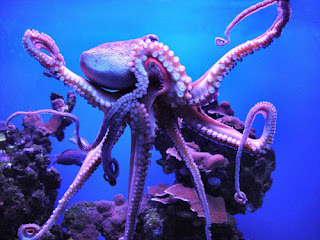
Octopus Farm Sisal

Octopus Farm
Sisal
After nearly 10 years of intense and fruitful research and
the work of a group of women from Sisal, on the Yucatan coast, and the first
successful farm work in the world of culture Octopus, in this case, Octopus
maya species endemic to the region.
"Elsewhere there have been attempts, but focused
especially fattening, which is different to raise them from hatching of the
eggs," said Guadalupe Villegas Barcenas, graduate of Marine Sciences and
Limnology at the Multidisciplinary Unit in Teaching and Research (UMDI)
campus Sisal, Yucatan, UNAM.
In aquaculture there is a long list of physical variables,
chemical and biological, to consider to cultivate a kind." Diet is
probably a crucial factor in the success of the crop. Ensuring the
survival and growth with a good nutritional status is a challenge that is
maintained throughout the process, "he said.
Breeding in the Wild
These animals begin their courtship reproduction in which
the male and female movements unfold, change color facing each other, and at
one point, the male leaves his sperm in couples. At the end of the third
arm or tentacle of that, there is a structure that introduces the
spermatophores or sperm packages in the mantle cavity of his companion.
"The sperm come together, say packed, hence its
name. Once you are inside the cavity, the eggs are fertilized, after which
the female ejects and takes them to a cave as a shelter prepared to continue
its development, "Villegas said Barcenas.
Continental shelf Yucatan specifically Sisal region, there
are many calcium carbonate formations, which being perforated by water seeping
allow sea caverns are formed. Among these, the female looking and packaged
for hanging on the ceiling their eggs around a filament that resembles a bunch
of grapes.
During commissioning and embryo development, which lasts
about 45 days, from hanging bunches until the animal leaves the egg hatches
or-, is dedicated to care. At all times, protecting them from predators,
and air resulting in a structure known as siphon kept clean of parasites.
The university indicated that "this process, which is
the only reproductive in her life, she stops feeding, and days after hatching
starving."
The Harvest
One of the features of Octopus maya is presenting
"direct development", ie born with the physical characteristics of an
adult. "I do not have a larval stage, and therein lies much of the
success of captive breeding, because other species do have, and feed a growing
is very difficult," he explained.
The harvest weight depends on its intended market, as some
prefer adults or small octopus. Sisal is grown in baby octopus, of average
weight 100 grams preferred by a type known as gourmet market.
This size is very ductile in the kitchen, because lets
prepare in various ways, and their flesh is very soft. Among the economic
benefits to the producer are that need less work and food, and its market price
is higher than the adult octopus.
Two Patents for UNAM
Octopus Research in UMDI is divided into two work
areas. One is the research itself, the experimental area, and the other is
the culture, which is integrated cooperative. The two work closely
together.
Cultivation began in the play area, which wild octopuses
reach adults, male and female, caught by fishermen. Once she has made with eggs
attached filament, the latter are removed and placed in incubators in which you
try to recreate the atmosphere of the cave.
The incubators used in its production system are the result
of the work of graduate students and researchers UMDI. Since 2010 are
patented for UNAM.
Upon hatching, the young are carried to the areas of
pre-fattening and fattening on, where they are fed. "In the culture,
the process is considered by some researchers as the most important factor,
because therein lies the economic viability of the project," he said.
In the wild, they eat mainly crustaceans like crabs, their
preferred-, fish and other cephalopods. In captivity, if you do not accept
what you are given, or if not nutritious enough, the breeding project does not
work.
Octopuses Fed Dog
Kibble
In other parts of the world have been used for surimi fish
sticks with artificial-ground, frozen chicken, and even dog
kibble. "These first attempts were pretty much trial and error,"
he said.
In 2010, Rosario Martínez (Autonomous University of
Guanajuato) developed a food with crab and squid, among other things, which was
well accepted. "In the UMDI, experimented on which Octopus maya fed
with fresh crab, the best that could be offered, but at a high
price. However, as giving good results are used as control diet in
experiments "said VillegasBárcenas.
"The work of Rosario Martinez, and many others before
yours, are very important because they were the beginning of a series of
experiments that allowed us to develop a good quality food at a lower cost,
with which the young grow fairly well.
"We did some experiments with ingredients and amounts
until it achieved an appropriate formula nutrients and production costs,
because one of the problems in the culture is the viability and
profitability. Since the patent is in process will allow the UNAM
commercialize, "he said.
Birth of the Women's
Cooperative
In the community of Sisal is a division of labor in which
men mainly go fishing, while women sell the product of fishing for the day, but
keep some for home consumption.
Artisanal fishing is the main economic activity, and one of
the most important fisheries in the country. However, during the closure
period of six months, you can not remove the product, so that in that period,
some practiced other trades in neighboring villages or in the city of Merida.
In 2005, with the aim of conserving the species and as an
economical alternative that provides income during the closure, the UNAM
community invited to join the project.
"From the outset, the men refused to participate, but
there is always very entronas women and purposeful, and with them, about six or
eight, started the job," recalled the researcher. "Later, some
fellow fishermen were integrated. After several years of research and the
work of the ladies, is thought to form a cooperative, which is called Mayab
Mollusks, which alludes to the biology of the species and the region. "
Although still not much, because although commercial
production is still in pilot stage, and there is a gain. At the time that
production is a large scale, will be greater. "But this compensation,
however small, will work," he said.
Knowledge Production
The crop group consists of researchers from the UMDI and
graduate students from various parts of the country and the world, which
provide the knowledge gained in their experiments. It forms a dumbbell
with the members of the cooperative in a bidirectional flow between science and
knowledge of the environment, and experience of the inhabitants of this coastal
town.
"Carlos Rosas, Pedro Gallardo, Cristina Pascual, Maite
Mascaro, Claudia Caamal (all the UMDI) are some masters of this great
crew," he said
Friday, July 19, 2013
Why doesn't the sand in the Caribbean burn your feet?
The sand on Yucatan Beach and in other parts of Caribbean is made from finely ground particles of coral and calcareous algae (a type of seaweed). The most common calcareous algae found in our sand are known as Halimeda. There are many varieties algae, but Halimeda is easy to recognize.
This small green plant is approximately 8”inches long when alive, and is frequently seen floating on the surface or washed up on the shore. There are numerous small-bead like segments connected
together which sometimes give the appearance of a necklace. Halimeda was given the common name “Sea Garland” back in 1640 by Parkinson. As the Sea Garland dies and changes colors, the small segments gradually turn white, fragment, and disburse as powder between the grains of sand. In this way, as much as 30% of the sand’s composition becomes a fine white organic powder, compliments of Halimeda.
Over hundreds of thousands of years, the corals and the Halimeda have laid down their lives to gradually build our famous beaches. The result is the fine white powdered sand that we so much enjoy today. As you walk on the beaches Topaz Beach, you will notice that the sand never gets hot, even under the midday summer sun. Say thanks to Halimeda, which does not absorb the heat. Have fun on
Yucatan Beach!
Saturday, July 13, 2013
Electricity Installation in Process
YUCATAN BEACH DEVELOPMENT - ELECTRICITY INSTALLATION IN PROCESS
The poles have arrived and electricity is being installed in compliance with CFE. We have had to cross many obstacles in order to extend the electricity to Topaz Beach but we have arrived at this major infrastructure addition and this will spark home construction and further development to the area. We have already contracted a few lots since the electricity installation became official.
We anticipate selling the remaining ocean front lots quickly.
This, coupled with other development in the area and the Government of Yucatan´s effort to promote Sisal as the next beach destination, makes for a great investment that you and your family can enjoy for generations: peaceful living by the sea with Merida, Yucatan´s greatest and SAFEST city, close by.
Friday, July 12, 2013
Monday, July 1, 2013
How to find a Perfect Beach
Do you know what to look for in a Perfect Quality Beach?
Not all beaches are equal!!
1) Elevation.
2) Reef Protection.
3) Amount of Sand.
4) Accretion Beach
5) Berm Saddles.
6) Firm Bedrock.
7) No Rip Currents or Strong Waves
8) Zoned Buildable Area
9) Last but not least, Beauty
If you would like to see some of our investment grade beaches, contact us today to see what we call perfect beaches!
Subscribe to:
Posts (Atom)


.jpg)